- Origin. Started with $500 in 1989, a recently-graduated finance major who taught himself out of the public library's investment-and-business-management section and earned the CPA at night. The path that started in a public library reading room with $500 in the bank led to liquidity events as an executive and again as an entrepreneur and investor.
- Credentials. CPA, MBA.
- Banking & credit foundation. Formal commercial-credit and commercial-real-estate credit training at First Union (now Wells Fargo lineage) and Barnett Bank (now Bank of America lineage) — before public accounting, which made me a better auditor than the standard sequence does. The underwriter's discipline that runs through every CFO seat since.
- Public accounting. Audit and tax practice; the CPA license came out of these years — reading workpapers with a lender's eye already trained.
- Public-company finance. Corporate Controller & Treasurer at Armor Holdings (NYSE roll-up; sold to BAE 2007 for ~$4.1B); CFO at Clarus Corp (NASDAQ; oversaw the 2010 Black Diamond + Gregory acquisitions), Highlands Acquisition Corp (NYSE SPAC), and Kanders & Company.
- Family Office CFO. Quarterbacked the full advisor pack across the family's businesses, investments, treasure assets, and tax decisions.
- Real-estate operator. Baratelli Properties — thirteen states, forty-plus cities, Extreme Affordable Housing thesis; currently revitalizing commercial property in Osceola, Arkansas.
- Company building. Cofounder of ReliaQuest (cybersecurity, 2007–2016); investor, board member, and former temporary CFO at Urban Mining (e-waste B Corp).
- What I am not. Not a registered investment advisor. Not an investment newsletter publisher. Not a Big-Four partner. The Institute is reference content from the practitioner seats described above.
I built the Baratelli Institute because I've spent the last thirty-five years mentoring people, and there's only so many people one person can sit next to.
The guides are how I'd tell you to solve the problem in front of you if I were in the room. The free interactive tools run the math I used to walk through on a yellow legal pad, except now they finish in sixty seconds instead of two billable hours. The Brief is the editorial I'd send a colleague when something on the practitioner desk shifts — a tax-code change, a deal pattern, a CFO seat that just opened. The cobrand mechanism lets an independent advisor put their name on the material and hand it to a client, the way a good mentor would hand the next chapter to a junior partner and say read this, then come back.
One of the main skills I've spent the last three decades developing is translating complicated technical concepts into language a non-technical person can actually use — the CFO explaining a covenant breach to a family-business owner; the cybersecurity operator explaining a managed-security program to a CEO who doesn't write code; the real-estate operator explaining a deal structure to a town council that's never seen a closing statement. The Institute is what that translation looks like at scale. Every guide, every tool, every Brief tries to do the same thing: take work that an expert practitioner does in their head and make it visible to someone who has to make a decision about it.
"Mentoring at scale. I've suffered through these calculations so you don't have to."
The work I've done over three decades is the source material. Everything in the library has been operated, not just observed.
In 2006 I met one of the founding partners of what's now one of the most respected boutique investment banks in the country — back when the firm was just a few people in a room. The bet was visible from inside even then: senior practitioners would do the work themselves, no army of analysts, no leveraging through juniors. The methodology would live in their heads rather than in a process manual.
Twenty years later, that firm sits at the top of the league tables on the deals that matter. The Baratelli Institute is the same bet, translated — the practitioner-shelf version, for the working operator, the family-office principal, the boutique founder, the senior CFO who can't hire that firm but can carry the methodology himself.
Family Office CFO · The Power of the Pack
Before the other chapters, I spent a meaningful stretch as Family Office CFO — the seat that sits at the center of a family's complete advisor team. The estate attorney. The CPA. The wealth advisor. The insurance broker. The trust officer. The art and collection appraiser. The trustee. The investment manager. Each of those advisors is excellent inside their own specialty. None of them, alone, can deliver what the family actually needs.
That seat taught me what I now call the power of the pack — and the quarterback concept that runs through every guide in the library.
"Each advisor is strong. All advisors properly led are unstoppable."
The job of the family-office CFO isn't to know more law than the estate attorney, more tax than the CPA, or more about markets than the wealth advisor. The job is to run the play — call the meeting, set the agenda, frame the decision, force the cross-discipline conversation the specialists wouldn't have on their own. The estate attorney and the CPA both need to be in the room when a §6166 election is on the table. The trustee and the investment manager both need to be in the room when the IPS gets refreshed. The CPA and the insurance broker both need to be in the room when the trust funding moves. None of those conversations happens by accident; they happen because someone in the Family Office CFO seat made them happen.
What I didn't realize when I took the seat: Family Office work is itself a tour of every industry the family touches. The family business — manufacturing, distribution, professional services, healthcare, retail, real estate, or some combination of all of them. The investment portfolio — public equity, private credit, venture, growth equity, direct real estate, alternatives, hedge funds, structured products. The holdings the family treats as legacy rather than investment — the classic car collection, the wine cellar, the watch case, the equine operation, the art on the walls, the airplane, the yacht, the vineyard, the family land. The philanthropic interests — the foundation, the donor-advised funds, the named professorships, the building plaques. Each one is its own industry, with its own operating reality, its own tax treatment, its own insurance market, its own disposition path.
That breadth is where the Treasure Assets Guide came from. Not from theoretical interest in collectibles — from the years of actually administering basis tracking on a 1967 Corvette at the same time as the maintenance reserve on a Citation jet, the agreed-value policy on a Patek Philippe collection, the lifetime-gift-vs-bequest analysis on a $40M wine cellar, the freeport-vs-domestic-storage decision on a contemporary art collection. The Treasure Assets Guide is the chapter notes from that work — made transferable to the next family-office CFO, wealth advisor, or estate attorney who walks into the same situation.
The same chapter is where most of the tax knowledge in the library came from. Family Office work is, at its honest core, a tax practice that happens to also touch investments. Every move — funding a trust, gifting an interest, exercising an NQSO, restructuring a partnership, selling a business, donating an appreciated asset, electing §645, electing §6166, qualifying for §1202 (subject to state-conformity analysis), qualifying for §2032A, moving residency — is first and foremost a tax decision. Estate tax. Gift tax. Generation-skipping tax. Federal income tax. State income tax. State estate tax. NIIT. Net Investment Income Tax. Section 1411. Section 1031. Section 1042. Foreign tax credit. PFIC. CFC. Subpart F. GILTI. The Estate Planning Decoded guide, the Liquidity Event Playbook, the Trust Administration guide, and most of the M&A tax chapters of the PE Guide are all chapter notes from that years-long tax practice — captured for the next practitioner who has to make the same call.
Every guide in the library — Family Office, CFO & Controller, PE, Estate Planning Decoded, Liquidity Event Playbook, Trust Administration, Treasure Assets — is in some way an instruction manual for that quarterback role. How to call the play. How to read the field. How to keep the pack moving in the same direction. The discipline I learned in the Family Office CFO seat is the discipline the Institute is built to teach.
"An athlete is essentially a Family Office in their late teens and early twenties now."
That observation is what the Athletes' Wealth Playbook was built on. NIL changed the math in the college sports ecosystem more than any rule change in the modern history of amateur athletics. A whole generation of college athletes — many of whom will never see a professional locker room — now graduate with six- and seven-figure earnings, a personal brand, an LLC, a Schedule C, multi-state tax exposure, agent fees, advisor fees, the questions every new high-net-worth household faces, and a thirty-year horizon to build on top of it. A nineteen-year-old college sophomore with an NIL portfolio is, structurally, a Family Office. Income from multiple revenue streams. A small advisor pack forming around them (or being assembled by their parents, or being sold to them by the wrong people). Tax decisions that will matter for decades. Entity-structure decisions that compound. Investment decisions that meet the same Investment Policy Statement discipline a $50M family deserves. The vocabulary is new to the athlete. Many of these athletes come from families that haven't dealt with this complexity before — the support network knows football or basketball or track, not §83(b) elections and quarterly estimateds and Schedule C versus Schedule E and S-corp reasonable comp. The AWP is the family-office playbook applied to that audience. It is written for the athlete, the parent, the coach, the NIL collective director, the agent, the booster who funds the collective, the wealth advisor whose new client just signed an NIL deal, and the CPA whose new client is eighteen with $800K of 1099 income across four states. Five editions in one license — Pro, College/NIL, High-School, Coach-Parent, Veteran — because the family-office discipline carries across every stage of the career window and the career window comes earlier now than it ever has. The athletes who graduate with a substantial nest egg and transition into a post-athletic career on stable footing are the ones whose family-office discipline got set up while they were still in school. The AWP is that setup manual.
"The same concepts of normal corporate assets apply to Treasure Assets. Both require proper tracking, storage, maintenance, valuation, and tax treatment. The Power of the Pack applies here too."
The Treasure Assets Guide was a function of moving to a Family Office position. In a corporate finance seat, no one thinks about Warhols, Koons, or Hirst. No one thinks about wine as an asset, or jewelry beyond personal use. When I ran a Family Office, all of that changed. I found myself walking the Gallery District of Manhattan, on my way to meet a gallery owner to discuss modern art. I looked like a JC Penney's model going to the Devil Wears Prada movie scene. The asset class was new. The clothes were wrong. The vocabulary was wrong. The room was wrong. But the discipline turned out to be the same discipline I had been running for twenty years in corporate finance.
The same concepts of normal corporate assets apply to Treasure Assets. Both require proper tracking, storage, maintenance, valuation, and tax treatment. A $40M art collection has a basis schedule the way a $40M equipment fleet has a basis schedule. A wine cellar has a maintenance regimen the way a manufacturing plant has a maintenance regimen. A classic-car garage has insurance and storage decisions the way a corporate jet has insurance and storage decisions. A watch case has provenance documentation the way an acquired subsidiary has IP-assignment documentation. The disposition decision tree — lifetime gift versus bequest versus sale versus charitable donation — is the same shape as the corporate-asset disposition decision tree. The vocabulary changes; the discipline does not.
And the Power of the Pack applies here too. Every Treasure Asset class has its own pack — the consultants, the dealers, the auction houses, the restorers, the appraisers, the agreed-value insurers, the specialty financiers, the freeport operators, the estate counsel who has actually dealt with the category. The art pack is not the wine pack is not the watch pack is not the equine pack is not the yacht pack. Each pack has its own specialists and its own seams between specialists where the work gets lost. The Family Office CFO who quarterbacks the broader advisor pack also has to quarterback these category-specific packs — same job, smaller scope, often higher stakes per item. The skills are very transferable. The Treasure Assets Guide is the reference for the practitioner making that transition.
"Estate planning and trusts are like air in the room of a family office. They surround all discussions. None of this magically happens — it requires the Power of the Pack to maximize the strength of the estate-planning investment."
Estate Planning Decoded and Trust Administration are really extensions of the Family Office Guide. Most everyone in the family-office world will learn about creating and administering trusts and estate planning — the two disciplines are not optional subsections of family-office work, they are the air in the room. They surround every discussion. Why? Family offices are normally created by late-career individuals with a real and present need to think about estate planning. The estate tax exposure is high. The wealth-transfer horizon is short. The next-generation conversations are overdue. Every meeting on the calendar — the quarterly investment review, the annual tax projection, the insurance renewal, the charitable planning, the family-business succession conversation — runs into the estate plan at some point in the agenda. Estate Planning Decoded is the reference for the creation side: GRATs, IDGTs, SLATs, ILITs, dynasty trusts, charitable remainder trusts, the §6166 / §303 / §2032A toolkit, the family LLC, and the conversations that have to happen with the client before any of it gets executed.
But here is the part most practitioners learn the hard way: the plan is half the work. Estate planning discusses the creation of the plan — but wait, you are not done. Guess what? Now you have to administer it. GRATs require an annual payment on a specific schedule that you can't forget. IDGT sales need their installment-note interest and principal tracked. SLATs need their independent-trustee reviews documented. Dynasty trusts need their generation-skipping inclusion ratios maintained. Trusts need their fiduciary income tax returns filed, their decanting decisions made when the trust no longer fits, their situs changed when the state's tax position shifts. None of this magically happens. It requires the Power of the Pack to maximize the strength of the estate-planning investment — the attorney who drafted, the CPA who files the 1041, the trustee who decides distributions, the investment manager who runs the trust portfolio, the insurance broker administering the ILIT premium, the family-office staff coordinating the whole machine. The Trust Administration Guide is the operating manual for that ongoing work, written from the family-office CFO seat that has to keep it all running for years.
You may be connected to the estate-planning pack for several years — and these are great relationships. Family-office advisors are tremendously talented and tremendously interesting individuals. The estate attorney who can walk through reciprocal-trust doctrine over coffee. The CPA who knows the §645 election cold. The trustee who has seen every family dynamic a dynasty trust can produce in three generations. The wealth advisor whose IPS discipline holds across market cycles. These are the people the Family Office CFO quarterbacks. The estate-planning chapters of the Family Office Reference Guide point at the technique; Estate Planning Decoded goes deep on the creation; Trust Administration goes deep on the administration; and the three guides together are the library for the practitioner who has to make all of it work.
"Money doesn't buy happiness — I don't believe that for a second. Money cures a lot of problems, but it creates an enormous amount of different problems."
Wealth Psychology came from the same Family Office seat that produced AWP, Treasure Assets, Estate Planning Decoded, and Trust Administration. Once an individual or a family has enough financial assets, the financial needs are met — and now the decisions and the lifestyle are no longer money-driven. They are psychology-driven. The founder who built the wealth typically has a rags-to-riches story behind them: the early sacrifice, the late nights, the discipline of foregoing comfort to compound capital. The family that grew up with the result of that work usually does not share the founder's willingness to sacrifice. That asymmetry is the central psychological tension of family wealth and the reason every family-office CFO learns this material whether they signed up for it or not.
After wealth, opportunities grow. Does the wealth change who the family is? Are they happy? I have heard people say, “Money doesn't buy happiness,” and I don't believe that for a second. Money cures a lot of problems. It also creates an enormous amount of different problems — problems most pre-wealth practitioners never see and most post-wealth practitioners never name out loud. The next-gen who hasn't been told what's coming. The spouse who manages the household but doesn't know the trust structure. The recent widow facing the first joint tax return alone. The founder afraid to retire because the work is the identity. The adult child who suspects an upcoming inheritance and reorganizes their career around it without telling anyone. The cousin who finds out about the family trust at a holiday dinner. Each of those is a conversation underneath a financial decision, and the financial decision will be wrong if the conversation underneath it does not happen first.
And then there is the long-arc problem. “Shirtsleeves to shirtsleeves in three generations” is the proverb of family wealth: the founder builds, the children steward, the grandchildren lose. Seventy percent of wealthy families lose the fortune by the second generation. Ninety percent by the third (Williams & Preisser, Preparing Heirs, 2003 — the canonical study). Other cultures have the same proverb — clogs to clogs in the UK, rice paddies to rice paddies in Japan — because the pattern is human, not American. The wealth-creator wants his children to do better than he did, and they usually become professionals; but the grandchildren are far enough removed from the traits that created the wealth that they no longer share the willingness to sacrifice. The Pack is there to help prevent the grandchildren from falling back to shirtsleeves. The financial-literacy education, the values conversations, the family-governance structure, the next-gen meetings, the philanthropy that anchors a multi-generational identity, the family-office continuity discipline — that is what the third-generation work looks like, and the Wealth Psychology Guide is the reference for the practitioner who is responsible to a family for getting it right.
One credential I have not held: I have never been a registered investment advisor. The Institute's wealth-advisor and athletes'-wealth-advisor material is not written from the RIA seat. It is written from the seat across the table from the RIA — the Family Office CFO seat that hires the wealth advisor, reads the IPS the wealth advisor drafts, sits in on the quarterly review the wealth advisor runs, and is responsible to the family for whether the wealth advisor's work fits the larger plan.
That seat reads more wealth-advisor work in a year than most wealth advisors produce in five. It is the seat from which the Family Office Reference Guide and the relevant chapters of the Athletes' Wealth Playbook were written. I am not the wealth advisor; I am the reader of the wealth advisor's work. The reader who picks up those guides is getting that perspective — not a substitute for the RIA's own training and licensure, but a complement to it.
First Union & Barnett Bank · Commercial & CRE Credit Training
Before public accounting and before any of the CFO seats, I went through formal commercial-credit and commercial-real-estate credit training programs at First Union and Barnett Bank — both regional banks that have since been acquired (First Union into what is now Wachovia, then Wells Fargo; Barnett into what is now Bank of America). The banks no longer exist as independent institutions, but the credit-training programs they ran were two of the most rigorous in the country at the time, and the discipline they taught is the discipline I have used in every seat since.
Banking before public accounting is not the standard CPA path. Most CPAs come out of college, start at a Big-4 or regional firm, learn audit and tax there, and then move to industry. I went the other direction — through the lender's seat first, then into public accounting after — and what I'll say honestly is that I think it made me a better public accountant than the standard sequence does. When the senior on the audit hands you the loan agreement and asks you to walk the debt-covenant compliance schedule, the auditor who has actually written loan documents reads that workpaper differently from the auditor who hasn't. You know what the lender was looking for when they negotiated the covenant. You know how to read the rate-and-fees schedule. You know what the personal-guarantee package was covering. You catch the issues a junior who has never sat on the other side simply doesn't catch.
Bank credit training is unlike any other finance education. It is not the analyst's job of building a model. It is the underwriter's job of pricing the risk that a borrower won't repay. You read the personal financial statement. You read the global cash-flow. You read the tax return. You read the loan-policy committee memo. You sit across from the borrower and ask the questions that decide whether the bank lends $500K or $50M, what the rate is, what the collateral package looks like, what the covenants are, what the personal guarantee covers, and what happens in workout if the deal goes sideways. Every CFO seat I have ever held has been better because I sat through that training first.
The commercial-real-estate credit training added an entire vocabulary on top: debt-service-coverage at the property level, loan-to-value at the appraised level, tenant credit-quality, lease-rollover schedules, environmental Phase I and Phase II reviews, the survey, the title commitment, the SBA-7(a) versus 504 versus conventional decision, the term-loan-versus-revolver call, the construction-loan-to-permanent take-out structure, the recourse-versus-non-recourse negotiation. Those mechanics are why the SBA Financing Packet, the Working Capital Peg Calculator, the Mortgage Underwriting tool, and the Bonding Capacity Strategic Review read the way they read — from inside the lender's seat, not from a textbook.
The Treasury and Banking chapters of the CFO & Controller's Reference Guide, the SBA-financing chapters of the Business Buyer's Guide, the debt-stack-architecture chapters of the PE Guide, the mortgage chapters of the residential real-estate work, and the gentrification finance chapters of the Gentrification Guide are all written from that early-career discipline. The CFO who has never been on the other side of the table reads a credit document differently from the one who has spent years writing them. The Institute is written for both.
Public Accounting · Audit, Tax, and the CPA License
After the banking chapter, I moved into public accounting — the audit-and-tax practice path that produces most CPAs. The work was the same work every public accountant does: audit engagements across a range of industries, tax return preparation and review, the engagement-letter and risk-acceptance cycle, the planning-fieldwork-wrap-up rhythm of the audit calendar, the partner-review and quality-control discipline that the AICPA and the state board require. The CPA license came out of those years.
What made those years unusual was what I brought into them. Auditing a commercial borrower when you have already drafted commercial-loan documents is a different experience from auditing one cold. Reading a personal financial statement on the schedule when you have already underwritten dozens of them is a different experience. Working a tax return for a closely-held business when you have already walked the cash-flow conversion at the bank is a different experience. The audit-and-tax chapters of the library — the auditor-coordination work in the CFO & Controller's Reference Guide, the §6166 deferral mechanics in Estate Planning Decoded, the QofE and working-capital-peg discipline in the PE Guide and Liquidity Event Playbook — are all written from that combined lens. The auditor who has been on both sides of the credit conversation reads the audit risk differently. The Institute is written for the practitioner who has, or who wants to develop, that same dual perspective.
Public Company Finance
"I used to joke that other companies had floors of people to do what I handled."
Before the Family Office CFO chapter, my finance career ran through a series of public-company seats inside the Warren Kanders operating platform — the discipline of running finance inside companies that have to report to the SEC, the audit committee, the underwriter, and the buyer's diligence team at a closing table.
Corporate Controller and Treasurer at Armor Holdings — the diversified armor and security-products business that grew through acquisition and sold to BAE Systems in 2007 for approximately $4.1 billion. The Armor Holdings chapter taught me public-company finance at scale: SEC reporting cadence, treasury at a multi-billion-dollar operating company, debt-stack architecture, the conversation with the underwriter, the conversation with the audit committee, and the conversation with the buyer's diligence team at the closing table that decides whether the deal you negotiated actually closes.
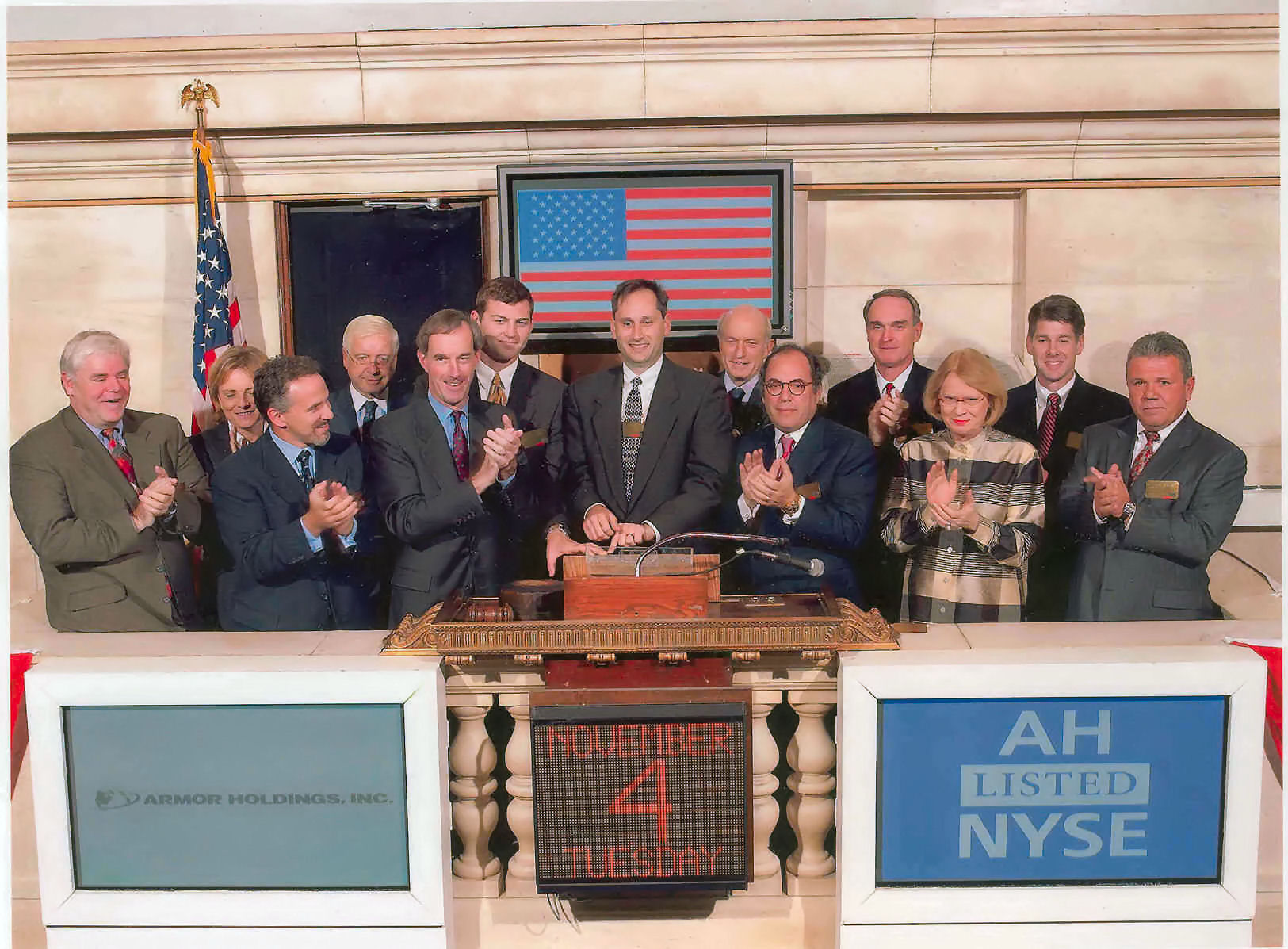
Corporate Controller and Treasurer, Armor Holdings, Inc. · November 4, 2003. THE NEW YORK STOCK EXCHANGE · That was twenty-two years ago. The Armor Holdings chair was the source material for the CFO & Controller's Reference Guide — and everything in the library since then is built on a longer ledger of seats and outcomes than that day represents.
Armor wasn't a giant Fortune-100 public company — and that turned out to be the right scale for the experience I needed. At a Fortune-100, the Controller doesn't touch treasury, the Treasurer doesn't touch capital markets, capital markets doesn't touch M&A, M&A doesn't touch the insurance program, the insurance program doesn't touch the equity-compensation program. Each function is its own department with its own VP and its own staff, and the seam between functions is where the work gets lost. At a mid-cap roll-up like Armor, those functions all sit on the same desk — my desk — because the company is the right size to require the discipline of a public-company finance function but not the right size to support a dozen siloed teams. The Controller IS the Treasurer IS the capital-markets contact IS the M&A buy-side accounting lead IS the insurance-program administrator IS the stock-compensation accounting owner. You see the seams firsthand because you are responsible for them. That's why every chapter of the CFO & Controller's Reference Guide and large parts of the PE Guide read the way they do — from the seat that had to integrate functions the Fortune-100 reader is used to reading about across separate departments. And over the course of those years, I went from joining the team to ultimately becoming a principal of the operating platform — not just an employee who held titles, but an owner of the strategy and a participant in the outcome.
One specific example, because the texture matters. In 2004, I was the company executive responsible for the corporate aircraft acquisition, financed through a synthetic lease. A corporate-jet acquisition is its own world — aircraft selection (cabin specs, range, mission profile), pre-buy inspection, FAA Part 91 versus Part 135 operating-rule decisions, hangar arrangements, crew employment structure, pilot training, the §280F entertainment-versus-business-use allocation that determines deductibility, and the IRS personal-use-disallowance rules under §1.61-21. The synthetic-lease structure added a second layer of complexity — an off-balance-sheet financing vehicle (a special-purpose entity holding title to the asset, leasing it back to the operating company on terms that produced tax depreciation for the SPE owner and a synthetic operating-lease P&L for us, under the pre-ASC 842 lease-accounting rules), the lender's covenants on the SPE, the residual-value guarantee mechanics, the FIN 46 consolidation analysis (a real question at the time, in the post-Enron environment), and the exit math at lease maturity. The depreciation-tax benefit on an approximately $13 million corporate aircraft was a meaningful part of the deal economics. Aircraft are 5-year MACRS class-life property, and in 2004 the Jobs and Growth Tax Relief Reconciliation Act bonus-depreciation rules were still in force — meaning a large portion of the purchase price was deductible in year one and the rest amortized rapidly over the early lease years. The synthetic-lease structure was designed precisely to route that depreciation benefit through the SPE owner (who could use it efficiently against their tax basis) while the operating company captured an operating-lease P&L profile and the SPE captured the off-balance-sheet treatment that mattered to our credit metrics. The deal worked because three things lined up at the same time — the aviation finance mechanics, the synthetic-lease accounting structure, and the corporate-aircraft tax-depreciation rules — and the Controller / Treasurer who lived inside that work had to be fluent in all three. The Treasurer's chair at a mid-cap roll-up ties directly into the tax function — debt-stack architecture turns on interest-deduction rules, equity-comp accounting turns on §83 and §409A and §422, capital-markets execution turns on the basis math, the M&A buy-side seat turns on the tax-attribute walk and the §382 limitation, the corporate aircraft turns on §168(k) bonus depreciation and §280F entertainment-use allocation, the insurance program turns on the deductibility of executive coverage. The tax fluency is not optional on this desk; it is the desk. The Treasury / Banking / Capital-Markets chapters of the CFO & Controller's Reference Guide and the entire tax-attribute-walk track in the PE Guide are written from inside that integration. That kind of cross-disciplinary, structured-finance treasury work is what training at Armor actually looked like. The Treasury, Banking, and Capital-Markets chapters of the CFO & Controller's Reference Guide and the structured-finance chapters of the PE Guide are written from inside that experience — not summarized from a textbook.
It also taught me acquisition accounting — from two angles at once, and at a deal cadence most CFOs never see. Armor Holdings grew through constant acquisitions. The roll-up was the operating strategy: dozens of transactions over the years built the diversified armor-and-security-products business that eventually sold to BAE. As Corporate Controller and Treasurer, I lived inside that cadence deal after deal — preparing the public-company financial information after each transaction (purchase-price allocation, goodwill impairment testing, ASC 805 vs ASC 350, pro-forma disclosures, the SEC comment-letter cycle when an auditor and a registrant disagree on a measurement-period adjustment) AND being inside the due-diligence room on the buy side (target-company quality of earnings, working-capital normalizations, the tax-attribute walk, the rep-and-warranty negotiations, the closing-statement reconciliation). The acquisition-accounting, QofE, roll-up-platform, and add-on-deal chapters of the PE Guide and the closing-mechanics chapters of the Liquidity Event Playbook are written from that work — both sides of the transaction observed at the same time, dozens of times.
"Whether you are in a PE firm, or growing company, you will eventually be executing PE strategies."
That observation is what the PE Guide was built on. The roll-up was not "private equity" in the legal-wrapper sense — Armor was a publicly-listed operating company, not a fund. But the discipline was identical. Sourcing pipeline. Target underwriting. LOI negotiation. Quality-of-earnings. Working-capital peg. Purchase accounting. Post-close integration. Portfolio operating cadence. Eventual exit. The wrapper changes; the work doesn't. Whether the holding entity is a PE fund, a public-company roll-up, a family-office direct-investing platform, or a corporate-development team running tuck-ins inside a Fortune 1000, the practitioner at the operating end of the work is solving the same problems with the same tools. Most CFOs of growing companies don't realize they're already running the PE playbook — they think of themselves as doing "corporate development" or "strategic M&A," which sounds different but produces the same financial models, the same diligence checklists, the same earn-out negotiations, the same Q-of-E firm interactions, the same TSA architecture. The PE Guide is the reference for that work, written from inside a decade of doing it through a publicly-listed wrapper. The PE professional reads it as a fund handbook. The corporate-development VP reads it as a tuck-in playbook. The mid-cap CFO reads it as the integration manual their inside-counsel told them they need. Same book; same chapters; three different reading angles; one thesis underneath all of them.
As Treasurer, I was the principal company contact for multiple public equity offerings (secondary offerings off the NYSE shelf, registered directs, the prospectus and roadshow work that goes with each), multiple public debt offerings (senior notes, secured debt, the indenture negotiation, the covenant package, the ratings-agency coordination), and the commercial banking relationship (revolving credit facility, term loan, letters of credit, treasury services, swap counterparty management). Capital-markets work at public-company scale is a layered conversation — the CFO sets strategy, the lawyers draft the documents, the bankers underwrite the transaction — but the Treasurer is the day-to-day operating contact who keeps every party moving on the same calendar. The Treasury, Banking, and Capital-Markets chapters of the CFO & Controller's Reference Guide and the debt-stack-architecture chapters of the PE Guide are written from that work.
I also drafted and managed the responses to SEC comment letters on the filings — the back-and-forth with the Division of Corporation Finance staff that decides whether your S-3 takedown clears in time for the offering window, whether your 10-K is deemed complete or has to be amended, whether the auditor's measurement-period adjustment gets accepted at face value or has to be defended in writing, whether the pro-forma disclosures in your 8-K acquisition filing meet the Article 11 requirements of Regulation S-X. The comment-letter cycle is real public-company work, it lives on EDGAR forever (a fact that focuses the mind on how carefully you write each response), and at a Fortune-100 it is handled by a dedicated SEC reporting team or the corporate secretary's office. At Armor it was handled by my desk — drafted in coordination with outside counsel and the engagement-partner auditor, but written, owned, and signed from inside the company. The SEC reporting chapters of the CFO & Controller's Reference Guide and the SEC-disclosure chapters of the PE Guide are written from inside that work, not summarized from the outside.
I also executed the company's derivative transactions directly — another piece of the integrated treasury role that lives on a dedicated desk at a Fortune-100 and lived on mine at Armor. Two recurring programs: selling puts on the company's own equity as part of the share-repurchase architecture (monetizing implied volatility, standing ready to buy stock back at strike if assigned, accounting treatment under ASC 480 / ASC 815-40 for freestanding equity-linked contracts on the issuer's own stock), and managing the interest-rate hedging program on the floating-rate debt (pay-fixed receive-floating interest-rate swaps against the revolver and term loan, ISDA documentation and CSA collateral management with the swap counterparties, the rating-trigger and threshold negotiations, hedge-effectiveness testing and documentation to qualify for cash-flow hedge accounting under ASC 815-30, the OCI-versus-earnings recognition pattern, and the disclosure obligations under ASC 815-10-50). Derivative execution is one more place where the work is structurally cross-disciplinary — the trade is a treasury decision, the documentation is a legal one, the accounting is a controllership call, the tax characterization is a separate analysis, and all four have to agree on every transaction before it goes on. The derivative-accounting chapters of the CFO & Controller's Reference Guide and the hedging-program chapters of the PE Guide are written from inside that work.
Inside Armor I also managed the company's equity-compensation program — administering option grants, restricted-stock awards, ESPP, performance shares — and accounted for all of it under ASC 718. That dual seat (running the program AND booking the expense) is rarer than it looks; most companies split it across HR and Finance and lose discipline at the seam. The stock-compensation chapters of the CFO & Controller's Reference Guide and the Management Incentive Plan (MIP) chapters of the PE Guide are written from that work.
I also administered the company-wide insurance program at Armor Holdings — property & casualty, general liability, product liability (which is a serious line in the armor and security-products industry), workers' compensation, employment practices liability, fiduciary liability, cyber, directors & officers, business interruption, and the umbrella stack on top of it all. Running a public-company insurance program across a roll-up platform — coordinating coverage as new acquisitions came in, managing the broker relationships, reading the policy language, negotiating renewals against the loss-experience modifier, and sitting with the audit committee on the annual risk-assessment review — teaches a layer of risk-and-insurance literacy that doesn't come from any other seat. The insurance chapters of the CFO & Controller's Reference Guide, the agreed-value-vs-ACV chapters of the Treasure Assets Guide, the umbrella-and-fiduciary chapters of the Family Office Reference Guide, and the municipal-insurance discipline in the Gentrification Guide are all written from that work.
After the Armor Holdings sale, three CFO seats inside related public-company and investment platforms:
Chief Financial Officer, Kanders & Company — the principal investment vehicle.
Chief Financial Officer, Clarus Corp (NASDAQ-listed) — public-company holding platform.
Chief Financial Officer, Highlands Acquisition Corp (NYSE-listed) — Special Purpose Acquisition Company (SPAC).
At Clarus specifically, I inherited and managed a substantial federal Net Operating Loss carryforward — the kind of NOL that is only valuable if you understand IRC §382 cold, because §382 limits the dollar amount of NOL that survives an ownership change. Working that NOL through a series of transactions taught me §382 limitation math, NUBIG/NUBIL adjustments, the post-TCJA indefinite-carryforward rules, and the deal-structure conversations that decide whether an NOL transfers or disappears. The §382 NOL Limitation Calculator on the site and the portfolio-company-tax chapters of the PE Guide are direct outputs from that work.
As Clarus's CFO, I also oversaw the 2010 acquisitions of Black Diamond Equipment and Gregory Mountain Products — two premium outdoor-recreation brands that transformed Clarus from an NOL holding shell into an operating outdoor-products company (the company would later rebrand around the Black Diamond identity). Two simultaneous public-company acquisitions taught me a layer of operating-finance work nothing else does: purchase-price allocation across multiple targets, intangible-asset valuation at the brand level, goodwill assignment at the operating-segment level, the §382 ownership-change analysis that decided how much of the NOL survived the deal, the proxy-disclosure cycle, the auditor coordination on opening balance sheets, and the post-close integration discipline that decides whether the combined company actually delivers the synergies the proxy promised. The acquisition-accounting and roll-up-platform chapters of the PE Guide are written, in part, from that experience.

Chief Financial Officer, Clarus Corp. THE NASDAQ STOCK MARKET · The 2010 Clarus acquisitions of Black Diamond Equipment and Gregory Mountain Products converted an NOL holding shell into an operating outdoor-products company. The acquisition-accounting and platform chapters of the PE Guide trace back to the work on this desk.
"Life is short. Buy the dream car. Don't listen to Dave Ramsey. I've never seen a sad person in a brand new red sports car with the top off."
The Liquidity Event Playbook was created from personal experience. I have been fortunate to experience a couple of these events in my career — the Armor Holdings sale to BAE in 2007, and the conclusion of my interest in ReliaQuest in 2016. The playbook is written from the wire-hit-the-account side of both, not from a textbook.
I did not come from money. I started with $500 in 1989. I was a recently-graduated finance major and I had quickly realized that school was drastically short on the tactical business skills the real desk requires. So I threw myself into the public library's investment and business-management section — reading every Buffett letter, every Graham chapter, every Drucker, every Porter, every accounting primer I could find. At the same time I went back to school at night to earn the CPA. The CPA and the public-accounting years were life-changing. They put me on the track that became Corporate Controller and Treasurer at Armor, then CFO at Clarus and Highlands, then Family Office CFO, then cofounder of ReliaQuest. The path that started in a public library reading room with $500 in the bank led to liquidity events as an executive and again as an entrepreneur and investor.
A liquidity event is two things at once. One is the financial side — the tax sequencing, the §1202 QSBS stacking, the rollover-equity decision, the working-capital peg, the escrow negotiation, the residency planning, the charitable substitution, the trust funding. That is the technical content of the guide and the calculators on the Institute site. The other is the psychological side. You wake up one day with the ability to provide different options for your family. That is a real transition, and most of the wealth-management industry does not write honestly about it. I went from driving old Honda Accords or a base Ford Mustang to buying a dream car. I am here to tell you: life is short. Buy the dream car. Don't listen to Dave Ramsey. I've never seen a sad person in a brand new red sports car with the top off. Turn up the music and go. You earned it. And as a separate matter of life lesson learned the hard way over thirty-five years, I will close with this: it is much easier to make more money than to cut costs on a fixed revenue amount. Most personal-finance writing inverts that — teaches you to cut your $5 coffee. The Liquidity Event Playbook starts from the other side of the trade.
Three CFO seats inside the same operating system — two of them at publicly listed companies (Clarus and Highlands), one of them at the SPAC stage from IPO through target search. Each taught a different version of the same job: knowing the numbers cold, knowing the deal cold, and being the practitioner who closes the gap between the strategic conversation in the boardroom and the operational reality on the desk. The PE Guide and the CFO & Controller's Reference Guide are, in large part, where I put what I learned from those years.
Baratelli Properties
Since 2019, Baratelli Properties has operated across thirteen states and more than forty cities. The thesis is what I call "Extreme Affordable Housing" — acquiring properties most institutional capital wouldn't touch, renovating them at a cost that keeps rents accessible to the working tenant, and managing them at the level of operating discipline most of the industry never bothered with. The work taught me that the gap between what's possible and what gets done in real estate is mostly a gap in operating attention, not a gap in capital.
Kathy Ireland Worldwide found the work in 2020 and we partnered on the platform for a period. That partnership has since concluded — I am no longer affiliated with Kathy Ireland Worldwide and do not represent the brand. What I took from the chapter: brand-licensed real-estate operating can scale, and the operating discipline I'd built at Baratelli Properties was what made that scale possible at all.
The current chapter of that work is in Osceola, Arkansas — a small town in the Delta that's spent forty years losing population and is now, slowly, building back. I've acquired several of the empty commercial properties along the main streets and have been renovating them over the last five years, one at a time. The Gentrification guide in the library is partly a reference book and partly notes from the Osceola project — the civic-CFO move, the developer-alignment move, the long-term-resident protections that have to happen if a small town's recovery is going to last.
"Nothing had to be created from scratch. Just stabilized and repurposed."
That observation is what the Gentrifying Small Towns guide was built on — and it came from an unexpected place. The intellectual move that opened up the work was a lesson borrowed from the e-waste world. At Urban Mining, the recycler I've been an investor, board member, and former interim CFO of, the business operates on a deceptively simple premise: a computer is just a box with parts inside it. Used enterprise computer equipment comes off lease, comes in for inspection, gets tested, gets refurbished — the failed component swapped, the case cleaned, the firmware updated — and goes back out as a working machine at a fraction of new-build cost. Everything inside the box is replaceable. The box itself is the asset; the parts inside are the maintenance variable. That framing turns out to be enormously powerful, because it changes what you're buying: you're not buying a depreciated machine, you're buying an engineered enclosure with a bill-of-materials that someone else has already paid the upfront capex for.
I started looking at the houses the same way. An Extreme Affordable Housing acquisition was no longer "buying a distressed home that needs a renovation." It was buying a box. The foundation, the framing, the envelope, the plumbing layout, the electrical run, the roof structure, the lot — all of it was an enclosure someone else had already paid the upfront capex for. What we were repairing or replacing inside the box was the maintenance variable, not the asset. The HVAC, the water heater, the kitchen, the bath, the floor coverings, the windows, the trim, the fixtures — each one was a swappable part. Treating the house as a box turned a "renovation" into a parts-replacement exercise on an engineered enclosure — and parts-replacement is faster, cheaper, and more predictable than ground-up construction every single time. It is so much faster and cheaper to start with an unused home and bring it back to liveable standards than to start from scratch with a vacant lot and no utilities. That was the operating thesis of Baratelli Properties across thirteen states and forty-plus cities.
Then, driving the country doing that work for years, I noticed the same pattern at the scale up. Every small American town I passed through looked structurally identical. A highway with a Walmart, a McDonald's, and a Dollar General. A courthouse square a half-mile off the highway with a cluster of walkable streets — cute buildings, brick facades, big plate-glass storefronts — and almost every one of those storefronts boarded up. A town is a box too. The utilities are already run. The streets are already paved. The water and sewer mains are already in the ground. The schools are already built. The hospital or clinic is already standing. The county government is already operating. The residential neighborhoods are already walkable. The commercial spine is already laid out around the courthouse the way American small towns have laid out commercial spines for two hundred years. Nothing has to be created from scratch — just stabilized and repurposed. The first town where I committed real capital to that thesis was Osceola, Arkansas. There will be others.
Small-Business Advisory & SBA Financing
Alongside the public-company finance and real-estate work, I've spent meaningful time on the other end of the M&A market — helping small-business owners and individual buyers acquire small businesses, almost all of them financed through the SBA's 7(a) and 504 programs. The owner-operator who wants to leave their corporate seat and buy a $2-8M-EBITDA business. The search-fund operator running their first deal. The family-business heir buying out a sibling. The trades-business buyer (HVAC, plumbing, electrical, landscaping, pool, pest, roofing) acquiring a service company that's been profitable for two decades and is now selling because the founder is retiring.
That work taught me the lower-end deal mechanics that don't show up in the public-company chapters: SBA 7(a) and 504 underwriting (DSCR, LTV, equity injection, collateral, FICO, the 5-test scoreboard), seller-note structuring (standby language, principal-deferment, the math that makes the buyer's SBA loan fit), working-capital pegs at the lower-middle-market scale, quality-of-earnings work without the institutional QofE firm, and the 100-day plan that decides whether the new owner actually keeps the team. Different scale, identical operating discipline. The Business Buyer's Guide, the SBA Financing & Underwriting tool, and the closing-mechanics chapters of the Liquidity Event Playbook are written from that work.
"Harness this pack of advisors and you will gain enormous confidence."
The Business Buyer's Guide had a specific trigger moment. The need has always been there — ten thousand baby-boomer business owners exit every month, and most of the buyers on the other side of those transactions are first-time buyers walking into the deal without a reference book. What turned the latent need into an actual guide was a friend who recently bought a small home builder. He received SBA financing and needed help with the financial modeling for the SBA loan package. He asked if I could help. A three-statement financial model with forecasts is as easy for me as falling off a log, so I said no problem. I built the package. The deal closed. And it occurred to me, sitting at my desk afterward, that the work I had just done was the same work every first-time SBA buyer needs done — and almost none of them have a friend who can build the financial model for them on a Saturday morning.
I knew other people needed this guide too. I had been mentoring another executive for over a decade and had recently recommended he start an acquisition strategy in his new role. He was the first person I sent a draft of the guide to. His response was simply, “Wow.” One word. That was when I knew the guide was on the right track. The audience extends well past first-time SBA buyers. Many people dream of buying a business and this guide is a great starting point. It is also a perfect client-education tool for a business broker to hand to a prospective buyer — the broker who wants a more competent counterparty across the table, not a more confused one.
My first experience with a local business broker was instructive. The broker was more concerned with me signing one-page NDAs than with actually discussing the transaction. The dynamic was upside-down: the broker, who was supposed to be the educator, was being protective; the buyer, who needed to be educated, was being processed. This guide changes that dynamic. The educated buyer walks into the broker's office having already read the SBA-7(a) underwriting math, the §338(h)(10) implications, the working-capital peg mechanics, the quality-of-earnings workflow, the seller-note structuring math, and the 100-day plan that decides whether the buyer just bought a job or actually bought a business. Once again, there are a whole host of professionals that live in this space with their own distinct language — the SBA lender, the M&A attorney, the QofE firm, the buyer's CPA, the title company, the search-fund mentor, the broker, and sometimes the seller's side counsel. Harness this pack of advisors and you will gain enormous confidence. That is what the Business Buyer's Guide is built to do.
ReliaQuest · Cofounder
I am a cofounder of ReliaQuest, the managed-security cybersecurity firm headquartered in Tampa, Florida. My active operating involvement concluded in 2016. The company has grown substantially under the leadership of others in the years since and any discussion of its current scale, strategy, or trajectory belongs to that leadership, not to me.
Urban Mining · E-Waste Recycler (B Corp)
I am an investor, board member, and former interim CFO at Urban Mining — the e-waste recycler and Certified B Corporation. Urban Mining is the company that gave me the mental model I later applied to extreme affordable housing and then to Gentrifying Small Towns. The business takes in used enterprise computer and electronics equipment at end-of-lease — servers, workstations, laptops, monitors, networking gear — inspects each unit, tests it, swaps out the failed component, cleans the case, updates the firmware, and resells the working machine at a fraction of new-build cost. The failed units get parted out: the working memory, the working drives, the working power supplies, the working chassis all go back into inventory as replacement parts for the next machine that needs them. Nothing gets thrown away that has another use cycle in it.
That operating model is where I learned the lesson I later applied everywhere: an existing engineered enclosure with a replaceable bill of materials is a fundamentally different asset than a brand-new build at full retail. A computer is just a box with parts in it. A house is just a box with systems in it. A small town is just a box with infrastructure in it. The mental move is the same in all three places. The Urban Mining chapter is the one where the lesson got named.
The interim-CFO seat at Urban Mining is also where I learned the operating discipline of a certified B Corp — the dual-mandate financial-and-impact reporting, the third-party impact-measurement cycle, the stakeholder-governance overlay that sits on top of standard GAAP, and the way the board agenda has to allocate time to the impact mandate without letting it slide into greenwashing. That work informs the sustainability-and-impact chapters of the Family Office and CFO Guides — the chapters that explain how to run a business whose mission is real without losing the operating discipline that keeps it solvent.
Value Investing · For Personal Account
I am an active value investor for personal account — not a registered investment advisor, not an investment newsletter publisher, not a fund manager. The discipline I practice in my own portfolio is Buffett-and-Graham fundamental analysis: read the balance sheet honestly, understand the business model end-to-end, buy at a discount to intrinsic value, hold through volatility on businesses that compound. That discipline is, in the end, the discipline of reading a balance sheet honestly. Whether you are inside the boardroom or outside it.
On a funny note: I still own the first stock I ever bought — Walmart, in 1990. True story. I bought it with a significant amount of my modest net worth. Three months later Saddam Hussein invaded Kuwait, the market fell, and the position was substantially underwater. I didn't panic. I didn't sell. The stock recovered, and the position taught me a valuable lesson about the quality companies underlying the public stock — a lesson that has nothing to do with the pick and everything to do with knowing what you own. I still hold those original shares thirty-five years later. That lesson pays dividends for me every day as I watch fear and greed do their thing in the market.
The same fundamental-analysis discipline runs through the relevant chapters of the Liquidity Event Playbook, the valuation-governance chapters of the PE Guide, and the capital-allocation chapters of the CFO & Controller's Reference Guide. The fundamental-analysis calculators on the Institute site — WACC, DCF Sanity Check, Three-Statement Quick-Builder, §1202 QSBS, §382 NOL Limitation, the others — are the same reasoning tools the discipline runs on. They are not stock-picking tools. They are reasoning-architecture tools for understanding a balance sheet, an income statement, and a tax position. The Institute is a publisher of practitioner-reference content. It is not an investment-advisory firm, and no part of the value-investing chapter or the calculators it points to constitutes investment advice or a recommendation to buy, hold, or sell any security.
The Baratelli Institute
The Institute is the work I am doing now. Eleven practitioner reference guides — Family Office, CFO & Controller, Private Equity, Liquidity Event Playbook, Estate Planning Decoded, Trust Administration, Athletes' Wealth Playbook, Treasure Assets, Wealth Psychology, Gentrifying Small Towns, and the Business Buyer's Guide — plus the Baratelli Brief (a recurring editorial publication), 139+ free interactive practitioner tools, and a cobrand mechanism that lets independent advisors put their name on Institute material and hand it to a client.
The thesis behind the Institute is the one I have spent thirty-five years getting confident enough to write down: I am confident of one thing — there will be no buyer of this library with the breadth of experience I have. Banking and credit training at First Union and Barnett Bank. Public accounting and the CPA license. Corporate Controller and Treasurer at Armor Holdings, a publicly-listed mid-cap roll-up that sold for $4.1B. CFO at Clarus, Highlands Acquisition Corp, and Kanders & Company. Family Office CFO. Cofounder of ReliaQuest. Board and former interim CFO at Urban Mining. Founder of Baratelli Properties across thirteen states and forty-plus cities. The seats are the source material. The library is what comes out the other end when you actually sit down to write the work into a reference a next practitioner can read.
The guides are the reference material. The tools are the working calculators. The Brief is the editorial cadence. The cobrand is the distribution mechanism that lets independent advisors put the work in front of their clients without having to write it themselves. I am the publisher. Not a fiduciary, not an adviser, not a fund — a practitioner-reference publisher, the way Bloomberg Press or Wiley Finance are publishers, but with one author and a single editorial voice running through the library. Mentoring at scale. I have suffered through these calculations so the next practitioner does not have to.
Every Company Becomes a PE Firm at Some Point
This is the universal observation that sits underneath everything the Institute publishes. Every company, once it has scale and a balance sheet, becomes a capital allocator. McDonald's is a real estate company with a sideline in burgers — Harry Sonneborn structured the franchise model in the 1950s so that the burgers funded the rent. EMI's Beatles catalog paid for the medical-imaging breakthroughs at EMI Medical. Amazon's AWS funded the expansion of the entire Amazon business — retail, Prime Video, Echo, Whole Foods, logistics. Berkshire allocates insurance float across operating businesses and public equities. In each case, the operating business that founded the company became the customer of a separate competence the company developed, and the high-margin segment funded the rest of the parent.
The pattern is universal because the underlying mechanic is universal. Once a company has free cash flow and competence, it stops being a single-business operating company and starts being a capital allocator across businesses it can fund. The discipline that separates a great parent from a mediocre one is capital allocation — the same discipline that separates a great PE firm from a mediocre one. The operating CEO and the PE managing partner are doing the same job at the high end: deploying capital across opportunities and measuring returns honestly.
What this means for the reader the Institute is built for: every advisor who serves a real company will eventually run into these concepts. The CFO at a $50M revenue business will eventually face the question of whether the company should be allocating capital to a second product line, an acquisition, or a buyback — PE concepts in the operating chair. The family office CIO will face it across the family's operating businesses and the public portfolio. The estate attorney structuring trusts will face it when the underlying assets are operating-business equity. The wealth advisor running a portfolio is making capital-allocation decisions every quarter. The CPA reading the financial statements is reading the result of capital-allocation decisions someone else made. The attorney structuring a deal is structuring a capital-allocation decision. The PE lens is the operating lens; the operating lens is the advisor lens; they are the same lens at different depths.
The Institute exists because the practitioner reflexes required to read capital-allocation work — ASC 740 deferred-tax mechanics, §382 NOL limitations, sum-of-the-parts valuation, three-scenario discipline, source-tag literacy, the difference between a pre-tax SOTP multiple and an after-tax DCF shield — are the same reflexes whether you are inside the company, allocating from outside as a PE firm, advising the family that owns the business, or reading the financial statements of a $1.75 trillion IPO. The library publishes the reflexes once and the next practitioner reads them, applies them, and teaches them to the practitioner after that. The PE Guide and the CFO & Controller's Guide and the Family Office Reference Guide and the Liquidity Event Playbook all share the same intellectual core because the work they describe shares the same intellectual core. Every company becomes a PE firm at some point. Every advisor will run into these concepts. The library is the reference shelf both audiences need.
Credentials
- Certified Public Accountant (CPA) · State licensure
- Master of Business Administration (MBA)
- Former CFO · Clarus Corp (NASDAQ), Highlands Acquisition Corp (NYSE), Kanders & Company
- Former Corporate Controller & Treasurer · Armor Holdings (NYSE; sold to BAE 2007)
- Former Family Office CFO
- Founder · Baratelli Properties (2019 — present)
- Cofounder · ReliaQuest (2007–2016; no current operating involvement)
- Board member & investor · Urban Mining (certified B Corp, current)
- Active value investor · Public equities + private deals, since 1989
A clarifying note on practitioner scope: the Baratelli Institute publishes practitioner reference guides; it does not provide personalized investment, tax, legal, accounting, or advisory services. Phil is not a registered investment adviser or broker-dealer and does not hold himself out as such. The library is reference material for licensed practitioners and informed individuals; specific recommendations belong to the reader's own licensed advisors.
Available For
For people building or running operating companies, family offices, and reference-grade practitioner shops, I am available on a limited basis for:
- Practitioner-grade collaboration — working alongside CFOs, family-office principals, and boutique founders on the chapters of the work that the library writes about (capital-allocation, treasury, M&A integration, post-close playbook, liquidity-event preparation, family-office build-out).
- Board and advisory roles — selectively, where the work fits the seats already on the resume (publicly-listed mid-cap, founder-led growth company, family office, B Corp, real-estate operating platform).
- Practitioner conversations with journalists, researchers, and the financial press — on the topics the library covers (PE, public-company finance, family-office operations, treasure assets, gentrifying small towns, athlete wealth, liquidity events).
- Speaking and writing — CFO conferences, family-office gatherings, university finance programs, and other venues where practitioner reference material adds to the conversation.
The Institute is the primary work; advisory engagements are taken sparingly. For inquiries: Steel61@proton.me.